Terpenes and the entourage effect — what science says
The aromatic compounds in cannabis are called terpenes. The theory that they shape cannabinoid effects is called the entourage effect — here's what we know.
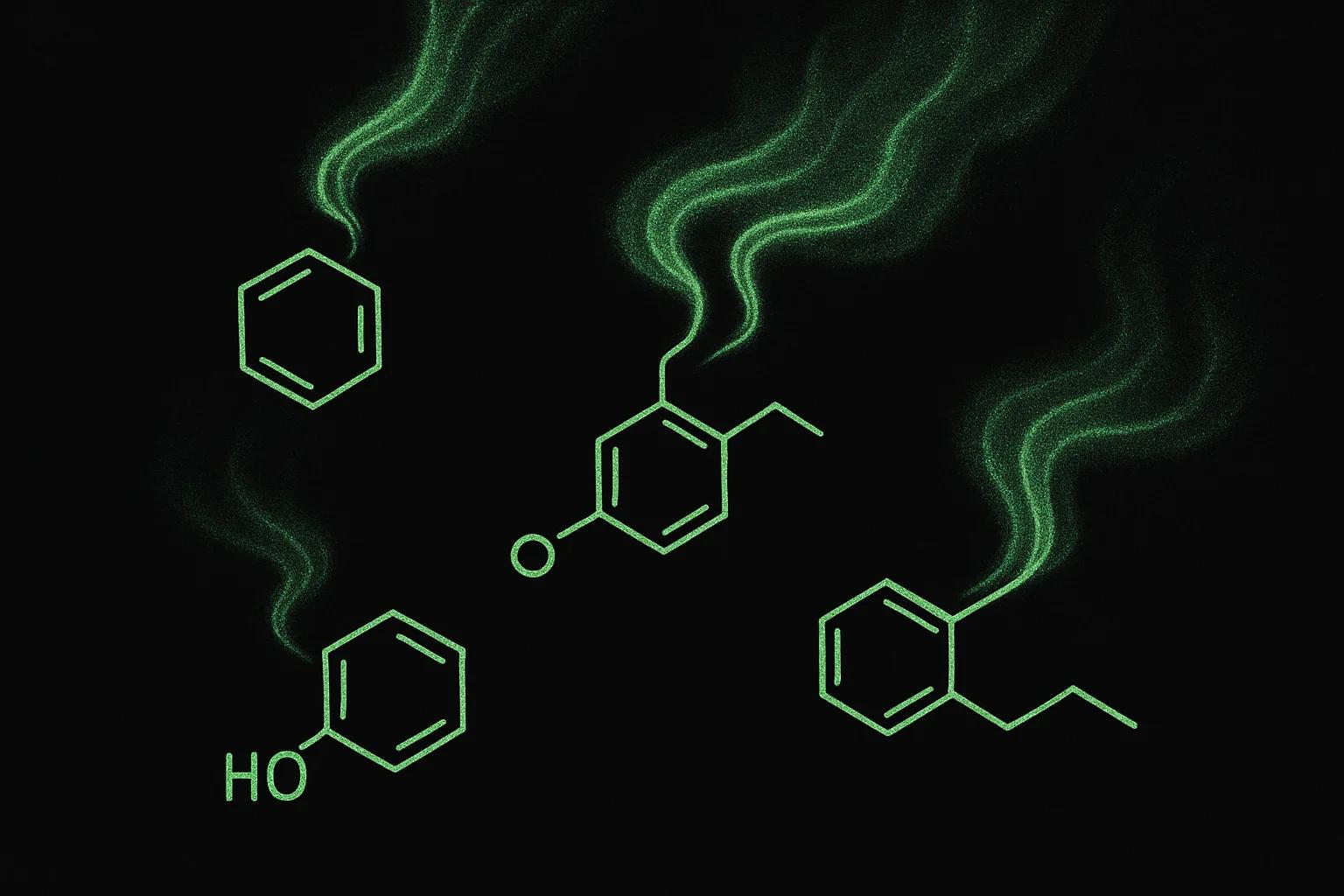
When you smell cannabis — lemon, pine, musk — you're smelling terpenes. These aromatic compounds are produced by the plant's resin glands alongside cannabinoids. They're not unique to cannabis: myrcene is in mango, pinene is in pine trees, limonene is in citrus peel. The interesting (and contested) question is whether terpenes modulate the effect of cannabinoids — the so-called entourage effect.
The main terpenes you'll see on a COA
- Myrcene — musky, earthy. Most common in indica-leaning strains. Often associated in marketing copy with relaxation, though the evidence is weak.
- Limonene — citrus. Common in sativa-leaning strains. Some animal studies suggest mood effects but clinical evidence in humans is limited.
- Pinene — pine, rosemary. Associated anecdotally with alertness. Pre-clinical data on memory and bronchodilation exists.
- Linalool — lavender, floral. Explored in anxiety and sleep contexts at the pre-clinical level.
- Caryophyllene — peppery, spicy. Unusual because it binds CB2 receptors directly, making it the terpene with the clearest cannabinoid-system interaction.
The entourage-effect hypothesis
The hypothesis, originally proposed by Ben-Shabat and colleagues in 1998 and popularised by Ethan Russo, suggests that whole-plant extracts deliver outcomes that isolated cannabinoids don't — because the terpenes and minor cannabinoids work synergistically. Mechanistically this could happen through receptor modulation, shared metabolism, or CNS-penetration effects.
What the evidence actually supports
In pre-clinical (animal/cell) studies: mixed support — some studies find synergy, others find no effect beyond cannabinoids alone.
In human clinical trials: the evidence is thinner. Whole-plant extracts often outperform isolated CBD in specific populations, but isolating whether that's due to terpenes, minor cannabinoids, or simply different pharmacokinetics is hard.
The honest summary: the entourage effect is a plausible hypothesis supported by uneven evidence. It is not a reason to dismiss isolate, and not a reason to claim full-spectrum is categorically superior. It's a reason to experiment and observe your own response.
Practical implication for product choice
If you believe the entourage hypothesis or want to test it, choose full-spectrum products. If you want precision and predictability, choose isolate. More on this in our extract-type guide.
Terpenes outside cannabis
Note: many terpene-forward marketing claims are genuinely plausible because these compounds have been studied for decades in aromatherapy and pharmacology contexts — independent of cannabis. That said, the doses used in clinical research are often much higher than what you'd encounter in a CBD tincture.